This website uses cookies for a better browsing experience.
See our “Privacy Policy”.
ICU Started From Fundraising
1.Road to founding a new university
The Pacific War came to an end in the summer of 1945. In the autumn of the same year, when all of Japan lay in ruins, a group of people inspired by faith and driven by a strong desire to contribute to building a peaceful nation began working toward the establishment of a new institution of higher education. At the same time, in the United States, there were people who wished to contribute to Japan’s reconstruction in order to atone for the suffering caused by the atomic bombings.
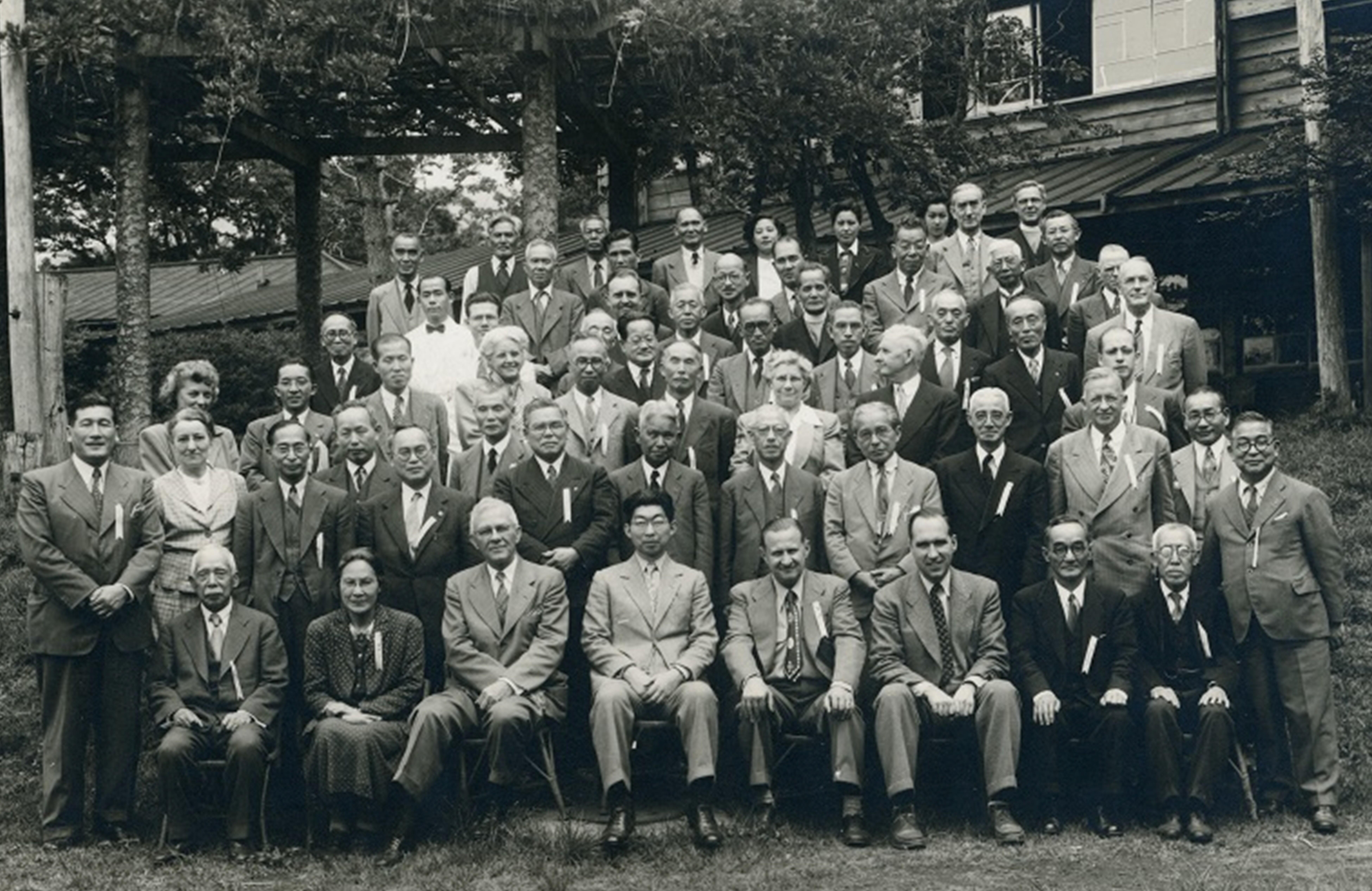
Reference 1. Group photograph of participants at the Gotemba Meeting
As these sentiments grew on both sides of the Pacific, individuals aspiring to establish a new university gathered in 1949 to hold a meeting in Gotemba, at the foot of Mount Fuji (Reference 1).
Japanese and Americans, who only a few years earlier had faced each other in war, came together in one place. They were united by the desire to found a university that would educate individuals to become leaders of a new Japan and of the world, and to serve the peaceful development of human society. At the Gotemba Meeting, participants decided on fundamental documents governing university administration—for example, the articles of endowment, as well as a governing structure consisting of the president, vice presidents, board of trustees, and council. This marked the starting point of the establishment of International Christian University.
2. Governor Ichimada of the Bank of Japan accepts the role of patron
The greatest challenge in establishing a new university was procuring sufficient funds for construction and operation. Fundraising activities had already begun in the United States. In Japan, members of the Japanese Planning Committee hoped to raise the funds necessary to purchase the university site. However, Japan at the time suffered from severe shortages of food and housing. This meant that extraordinary effort would be needed to raise the funds and establish the university. The area of the planned construction site in Mitaka, Tokyo, exceeded 1.3 million square meters (approx. 400,000 tsubo), with a fundraising goal of 150 million yen. The final amount raised was 160 million yen—a staggering sum equivalent to approximately 6 billion yen at today's value (based on a comparison of starting salaries for civil servants). If one were to purchase a site of the same size today, the cost would be tens of times higher, making it an extraordinary asset of immeasurable value.
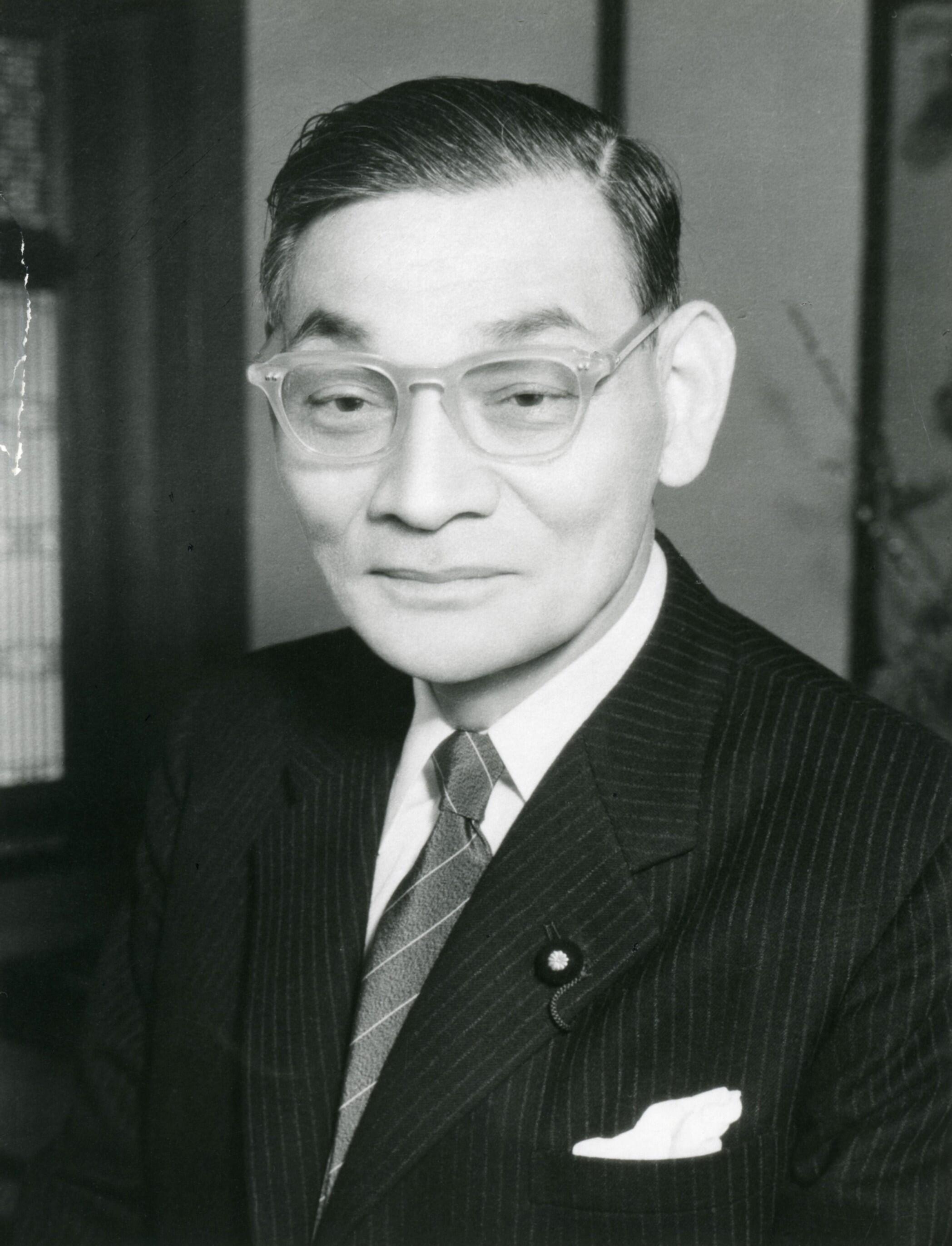
Reference 2. Hisato Ichimada, 18th Governor of the Bank of Japan
Professor Tadaoki Yamamoto (Chairperson of the Planning Committee) consulted many people about how to raise the funds. One of the suggested ideas was the almost quixotic proposal of importing used stockings from overseas, repairing them, and selling them to raise money. Some people dismissed this idea as little more than a fanciful dream.
One of those consulted was Ichizaemon Morimura, a leading figure in the business world and a devout Christian. After careful discussion, Yamamoto and Morimura decided to seek the cooperation of Hisato Ichimada (Reference 2), who was Governor of the Bank of Japan and the most influential economic figure in Japan at the time.
The two visited the Governor’s Office on the second floor of the Bank of Japan’s main building. Speaking passionately of their vision for establishing International Christian University, they earnestly requested that Ichimada assume the role of patron and lead a fundraising committee to raise 150 million yen.
Governor Ichimada believed that Christian-based education was essential as a spiritual foundation supporting the nation. He also held that Japan must aspire to become a trading nation trusted by the international community. Ichimada envisioned Japan as committed to freedom and peace, and beloved internationally, and felt that such a future required institutions of higher education where Christian values could be learned. Although not himself a Christian, Governor Ichimada strongly felt the necessity of faith in education. Convinced that the new university would nurture individuals capable of contributing to international peace, he accepted the role of patron.
3.Commitment to fundraising activities
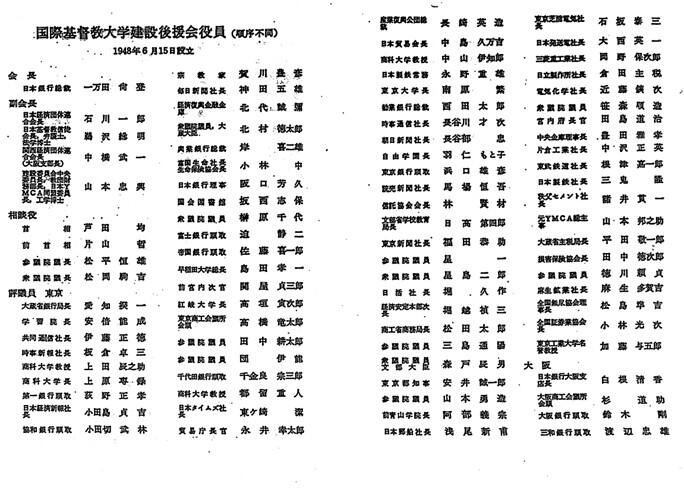
Reference 3. List of officers of the Support Association (excerpt)
Fundraising efforts within Japan began immediately. The first step was to establish an office at the Japanese Red Cross Headquarters in Minato Ward, Tokyo, and to secure administrative staff. In addition, the Patron's Association was established as an organization to support the fundraising campaign.
Hisato Ichimada (Governor of the Bank of Japan) was appointed President of the Foundation. The four Vice Presidents were Ichiro Ishikawa (Chairperson of the Japan Federation of Economic Organizations), Fusaaki Uzawa (President of the 日本基督教信徒会(Japan Christian Association)), Buichi Nakahashi (Chairperson of the Kansai Economic Federation), and Tadaoki Yamamoto (Chairperson of the Central Committee of the Construction Committee). Former and sitting prime ministers, as well as the speakers of both houses of the Diet, were invited to serve as advisors. Approximately 300 individuals—including politicians, leaders of industry associations, senior government officials, and university presidents—joined as officers of the Patron's Association to form a grand organization that mobilized the entire nation (Reference 3).
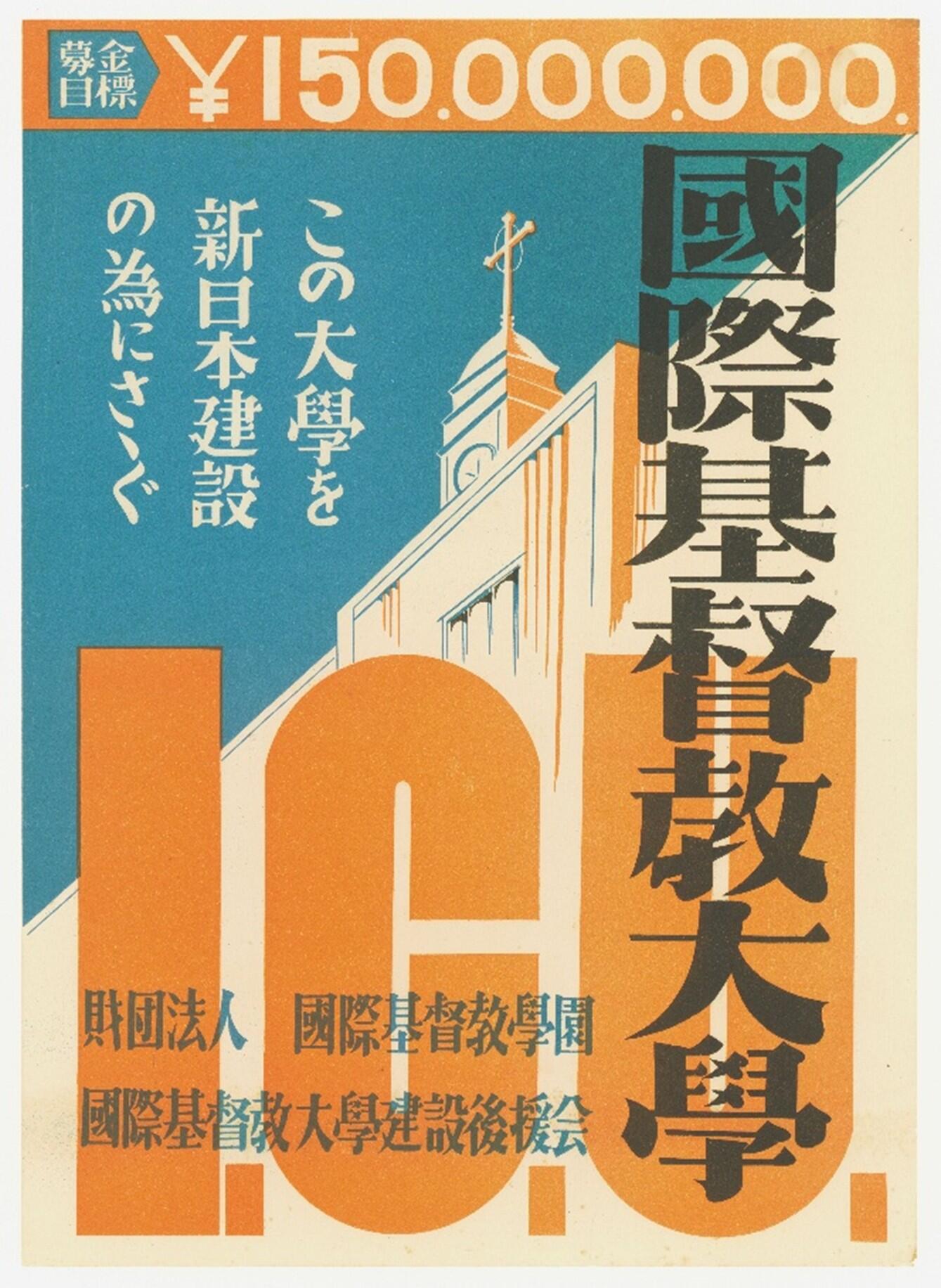
Reference 4. Poster
The Support Association established branches throughout Japan, with governors, presidents of chambers of commerce, and bank presidents serving as branch heads. In this way, a nationwide fundraising framework took shape, and support for the founding of International Christian University spread as a true national movement.
In an era without television or the internet, publicity for the fundraising campaign was carried out primarily through printed materials. A poster designed by Sanpei Kotabe and used at that time is still preserved today (Reference 4). Ten thousand copies of this poster were printed and distributed to branches nationwide. The poster prominently featured the university name International Christian University, the slogan “A University Dedicated to the Construction of a New Japan,” and the fundraising target amount. The name of a university that no one had ever seen or heard before was fresh and highly impactful. The poster intuitively conveyed that ICU was worthy of being entrusted with Japan’s future.
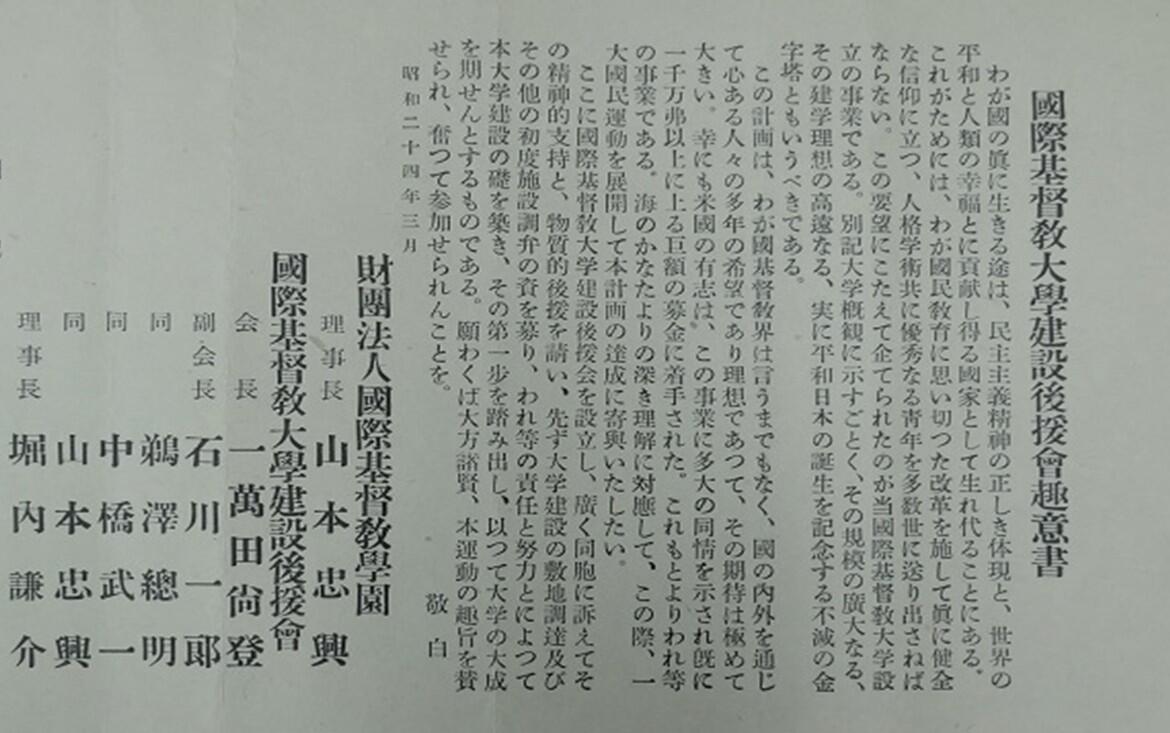
Reference 5. Prospectus of the Support Association for Construction of International Christian University (excerpt)
As stated in the prospectus, the purpose of the fundraising was “to provide society with young people of outstanding character and scholarship, grounded in sound faith.” (Reference 5)
In addition to academic excellence, the purpose emphasized the cultivation of individuals of superior character. This reflected a deep sense of remorse that the excessive focus on academic achievement in higher education prior to World War II had led Japan down the path to war.
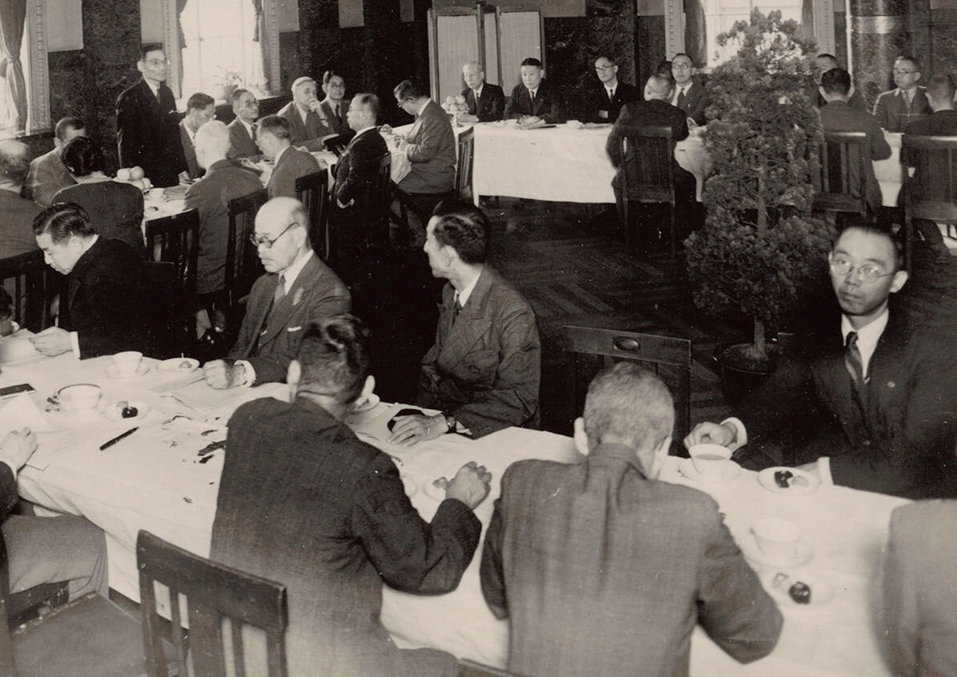
Reference 6. Governor Ichimada delivers a speech at a gathering of business leaders
Governor Ichimada actively participated in fundraising efforts, gathering influential business leaders and appealing to them on the necessity of International Christian University in building a peaceful world. (Reference 6)
Records also indicate that an all-star baseball game between eastern and western Japan was held as part of the fundraising activities, although it appears that the proceeds were modest.
4.Anecdotes related to fundraising
Many anecdotes related to the fundraising efforts have been preserved.
Children refrained from buying candy with their pocket money, instead making donations of 10 or 20 yen. Several university students donated 100 yen each to help realize the new university. They had earned this money through part-time work. There are also records of public high school students donating 10 yen per student.
Furthermore, remaining documents indicate that a donation was received from the Imperial Household. Dr. Hachiro Yuasa, then President of Doshisha University, wrote in his own book that he sold his entire research library on entomology to raise funds for his assigned donation.
In addition to leaders in politics and business, people from all walks of life and of varying financial means donated to ICU. Their donations conveyed the hope for a democratic education that respected individuality. It is also noteworthy that most Japanese donors at the time were non-Christians.
The ICU University Library has preserved donor name cards for 26,000 individuals. Some of these cards are available for viewing. The sentiments of each donor are etched into every single card, continue to quietly convey their message even today. (Reference 7).

Reference 7-1. Drawers of donor name cards
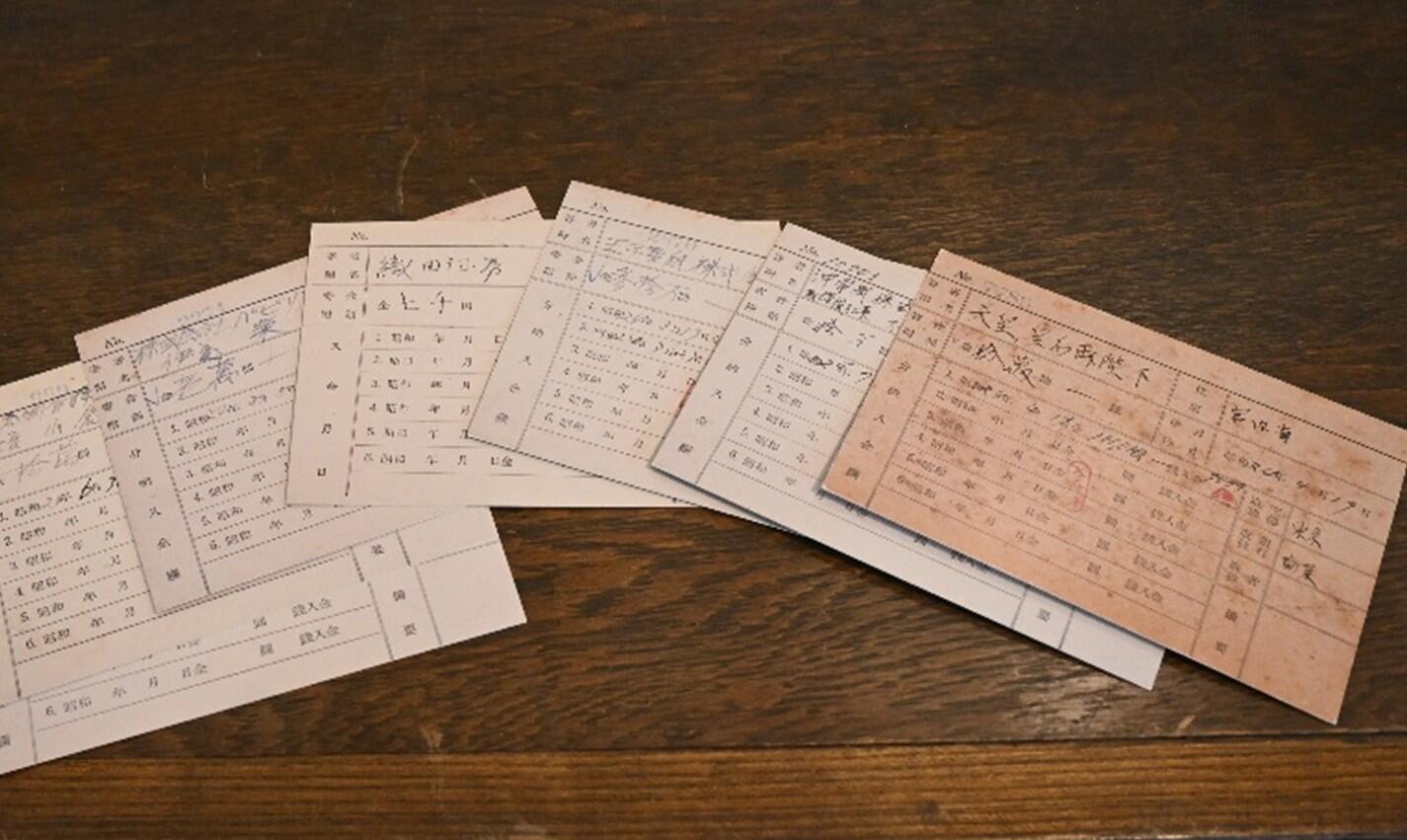
Reference 7-2. Donor name cards (excerpt)
Why did so many Japanese people lend their support to the founding of International Christian University? The reason is that they entrusted ICU with their profound wish that the painful wartime experiences they had endured would never be repeated by their children or grandchildren. From the depths of their hearts, donors hoped that students educated at this university would become leaders in society and contribute to the building of world peace.
5.Purchase of site for Mitaka Campus
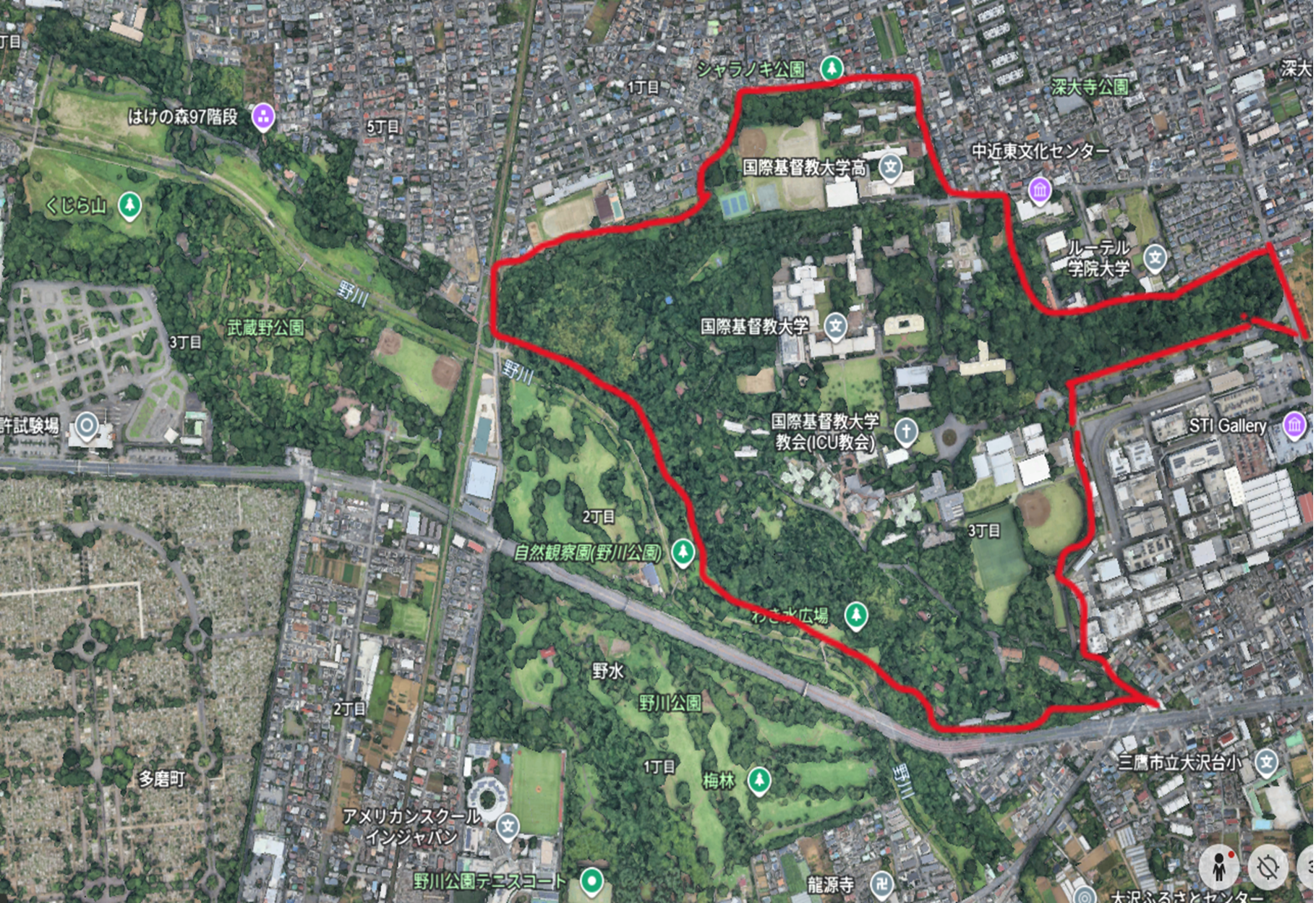
Reference 8. The green area indicates the original campus site (the red outline shows the current campus)
The fundraising campaign achieved remarkable success and surpassed its target amount. This made it possible to purchase the site of the present Mitaka Campus (Reference 8).
However, the story does not end there.
In fact, since its founding, ICU has never recorded a fiscal surplus. In the early years, donations were used to cover the operating deficits. However, as donations gradually declined, large deficits had to be offset by drawing down reserves. Consequently, in the 1970s, a portion of the campus land purchased with the founding-era donations was sold to the Tokyo Metropolitan Government. The sold portion is now part of Tokyo Metropolitan Nogawa Park. The proceeds of the sale were invested as financial assets, and the returns have since supported the financial foundation of ICU. This financial structure remains unchanged today. The small class size and other distinctive educational features of ICU continue to be sustained by the donations raised at the time of its founding. This culture of donating has been passed down among alumni. We hope that it will continue to grow as a cherished tradition, inspiring new donations that nurture future generations.
References
International Christian University: An Adventure in Christian Higher Education in Japan, C. W. Iglehart, International Christian University, June 1964
Hisato Ichimada: Biography and Memorial Volume, Ichimada Hisato Biography and Memorial Publication Committee, Tokuma Shoten Publishing, January 1986
Higher Education for Tomorrow: International Christian University and Postwar Japan, Kiyoko Takeda, ICU Press, June 2003
July 1950: Records of the International Christian University Construction Patron's Association, ICU Public Information Office, Office in charge of Compiling the 50-year History of ICU, March 1995