

Community Service-Learning
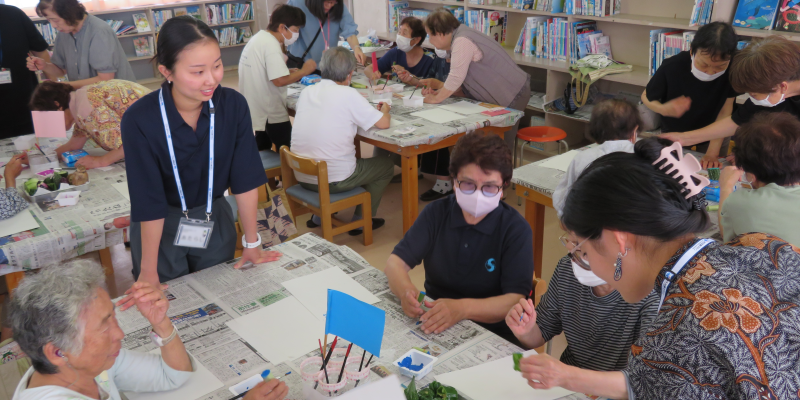
Community Service-Learning (CSL) is an experiential learning program in which students engage in approximately 30 days of service activities with non-profit organizations (NPOs), educational institutions, welfare facilities, local governments, public agencies, and community organizations throughout Japan. Through direct engagement with local communities and the social issues they face, students deepen their understanding of society by connecting classroom learning with real-world experience.
Service-Learning emphasizes not only volunteering, but also the process of selecting activities based on one's own interests and concerns and reflecting critically on those experiences to deepen learning. Students are therefore encouraged to consider how their service activities relate both to community needs and to their academic studies at ICU.
There are two ways to participate in Community Service-Learning: by joining a program offered through one of SLC's partner organizations, or by designing an individually arranged placement ("Self-Arranged Program") that students develop and organize themselves.
ICU's Partner Organizations
The Service-Learning Center (SLC) collaborates with organizations and communities with which it has established long-term partnerships to provide Community Service-Learning opportunities. Because SLC coordinates arrangements with host organizations, these programs are especially accessible to students who are new to Service-Learning.
Asian Rural Institute (Nasushiobara, Tochigi)
The Asian Rural Institute (ARI) is a training institution that welcomes rural development leaders from across Asia, Africa, and other regions to learn about sustainable agriculture and community building through hands-on experience. Students participate in activities such as organic farming, cooking, and supporting the operation of the institute while living in a diverse community. Through daily interaction and communal living with people of different nationalities, cultures, religions, and values, students gain a deeper understanding of the concept of "living together."
Tenryu Village (Nagano)
This program takes place in Tenryu Village, the southernmost village in Nagano Prefecture, where students live and work alongside local residents to address community challenges. Through activities that connect producers and consumers and make use of local resources, participants explore approaches to sustainable community development. Daily interaction with local residents and community life provides valuable opportunities to learn about rural revitalization and the role of local communities in contemporary Japan.
Nagasaki Foundation for the Promotion of Peace (Nagasaki City, Nagasaki)
This program supports activities aimed at achieving nuclear disarmament and lasting peace in Nagasaki, one of the cities affected by the atomic bombing. Through participation in peace education programs for young people, public events, and initiatives that preserve and share memories of the atomic bombing, students learn about peacebuilding in practice. Encounters with survivors and individuals engaged in peace-related work encourage deeper reflection on peace studies, human rights, and intercultural understanding.
MORIUMIUS (Ishinomaki, Miyagi)
MORIUMIUS is an educational and community-building organization that emerged from efforts to revitalize the region following the Great East Japan Earthquake. Students support children's programs, participate in agricultural and fisheries-related activities, and engage with local residents while learning about sustainable living in harmony with nature. Participants may also conduct research on local issues and develop independent projects, cultivating the ability to identify challenges and take initiative in addressing them.
Matsusaka City (Mie)
This program was established under the partnership agreement between Matsusaka City and ICU concluded in 2022. Centered on the Ichijōjiki (One-Tatami Mat Room) associated with Matsuura Takeshirō and preserved at ICU, students engage in activities primarily at the Hachiro Yuasa Memorial Museum (ICU) and the Matsuura Takeshirō Memorial Museum in Matsusaka City. Through these activities, students communicate the life, ideas, and achievements of Matsuura Takeshirō from a student perspective.
Participants contribute to exhibition development, public relations, educational support, and community revitalization initiatives while deepening their understanding of the history and culture of Matsusaka. Through collaboration with local residents and partner organizations, students gain practical experience in the preservation and effective use of cultural resources.
Self-Arranged Program
One of the defining features of Community Service-Learning is the opportunity for students to propose and develop their own placements. Students may identify an organization or community that aligns with their interests and concerns and design a service-learning experience that reflects their personal learning goals.
Students may either establish new partnerships with organizations or build upon placements that previous participants have undertaken. Because both the content and timing of activities can be arranged flexibly, students are able to create learning experiences that connect closely with their academic interests and future aspirations.
The SLC supports students throughout the planning process by providing advice on identifying potential host organizations and communicating with prospective partners. To date, ICU students have carried out Community Service-Learning projects with more than 100 organizations and institutions across Japan.
Host Organizations for Community Service-Learning
- 大熊未来塾
- キッズドア
- しげんCafeわくわく
- じぶん未来クラブ
- 世田谷区立明正小学校
- チャルジョウ西会津農場
- 富士山科学研究所
- フリースペースコスモ
- 三鷹市地域福祉課
- Dari K株式会社
- NPO法人ezorock
- NPO法人キッズドア
- NPO法人抱樸