

Winter Term AY2025
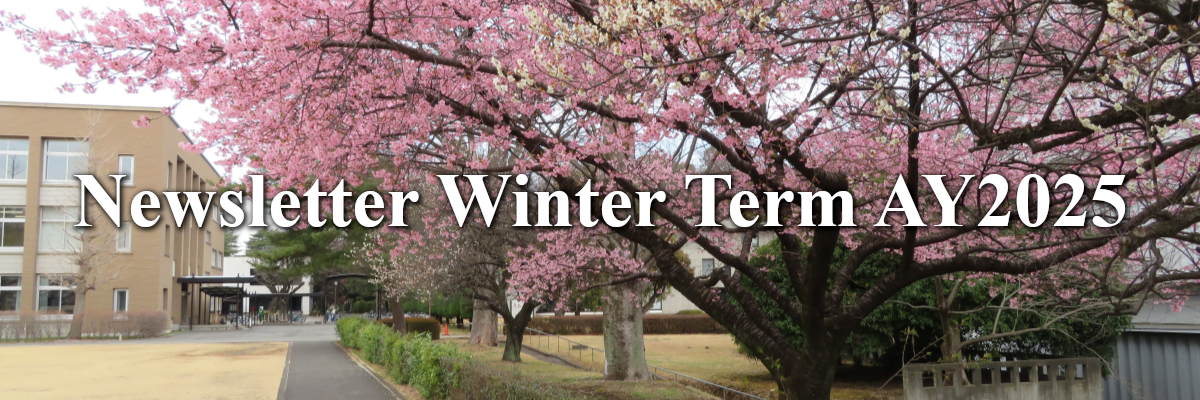 photo: Kawazu cherry blossoms at ICU Library
With the start of the Winter Term, the Service-Learning Center carried out the Japan Service-Learning (JSL) Program. We welcomed four students from India and the Philippines, who spent two weeks engaging in service activities while building warm connections with local community members and ICU students. As the campus and city gradually took on the colors of Christmas, it was truly memorable to see the participants immerse themselves in Japanese culture and customs, making new discoveries and deepening their learning each day.
In this issue, we highlight the JSL Program by sharing reflections from the participating international students, the host organizations, and the ICU students who supported the program as volunteers. In the latter part, SL Ambassadors who are preparing for graduation reflect on their learning through Service-Learning and the path ahead.
We hope that the encounters and learning gained through Service-Learning will continue to strongly support each student in their journey ahead.
We also hope that the connections formed through various activities will continue to be nurtured and further developed together with all of you.
Topic
- Service-Learning (SL) Ambassadors Launch New Instagram Account
- The Japan Service-Learning Program (JSL) was Held
Contents
- Voices of Overseas JSL Participants
- Voices of ICU Students joined as Volunteers
- Voices of JSL Partner Organizations
- Coordinators of JSL Program
- Reflecting ICU by the Graduating Students
- Message from the Director of SLC
- Editor's note
Voices of Overseas JSL Participants
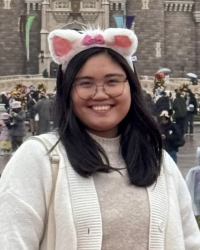
JAM FRANCINE G. GRAMATICA
Silliman University, Philippines
For a little background about me, I want to share that my current program, Social Work, which taught me so much about service-learning, is my take on a leap of faith. During my freshman year of university, I was in a business-related program, envisioning myself working in the corporate world years thereafter. However, things took a different turn; hence, I shifted to my current program.
Throughout my years as a Social Work student, I have engaged in service-learning activities, mostly because of academic requirements. However, because of my experience of being a Silliman buddy for the ICU students who participated in the International Service-Learning Program 2025, my perspective of service-learning changed drastically. Therefore, upon learning about the applications for the Japan Service-Learning (JSL) Program 2025, I initially hesitated, but took the opportunity because I believed that I had nothing to lose anyway.
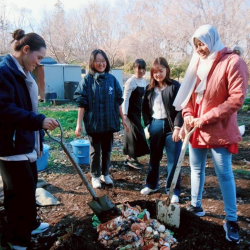
The JSL Program was an experience that I would carry with me throughout my future professional and personal life. On campus, helping ICU Compost with their tasks was an eye-opening experience for me, as I realized that composting can really help out with sustainability. Additionally, I was able to attend Sunday service, whereby I was able to observe the spiritual practices of locals. Through our engagements in different schools, I was able to get a glimpse of the Japanese education system. I was able to observe how students act in class and witness different teaching efforts of the educators. Notably, the Cosmo Free School experience made me realize that being different in spite of social norms is understandable and valid. Moreover, I was beyond touched with community efforts, such as Chi Q-Jin and Kobokan Community Center. I appreciate how older community members take an active role in shaping the hearts and minds of the young ones. Importantly, I felt like I belonged to the family during our home visit, playing games and sharing stories while having a hearty meal; I even miss my host family. Although I have a fear of heights, the Tokyo Skytree excursion was such a beautifully mesmerizing experience. For our free time, I was able to explore Tokyo alone. I went to Tokyo Dome and roamed around Shibuya, where I was able to visit different stores, with the Disney store being my favorite. For our collective free time, we went to Tokyo Disneyland. It was a very windy and rainy day; thus, we got extremely cold. However, we enjoyed the entire day in Disneyland; the cold never bothered us anyway.
Overall, the JSL Program 2025 was a fruitful exposure to an entirely different community and culture. If given a chance, I would still go back and explore more of Japan and its communities. Although it was a short program, I have learned a lot beyond the engagements we had. Importantly, the program personally represented a meaningful step toward becoming a more competent, compassionate, and culturally responsive individual.
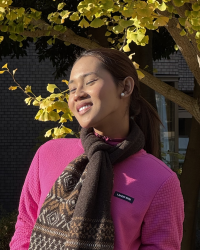
THOMAS DAVE RIXAN H. GARGANIAN
Silliman University, Philippines
Konnichiwa!
Being part of JSL and having the opportunity to experience Japan has been one of the most meaningful chapters of my student life. What started as a journey to a new country became a journey of self-growth, cultural appreciation, and lifelong connections.
Japan welcomed us with discipline, respect, and a deep sense of community. Through JSL, I was able to immerse myself in Japanese culture--from understanding their values of punctuality and humility to witnessing how tradition and modern life beautifully coexist. Every train ride, shared meal, and cultural exchange taught me lessons that no classroom alone could offer.
What made the experience even more special was the people. JSL created a space where students from different backgrounds could connect, support one another, and grow together. We learned not only about Japan, but also about ourselves--our resilience, adaptability, and appreciation for diversity.
This experience taught me to be more grateful, open-minded, and confident in stepping outside my comfort zone. It reminded me that learning goes beyond books; it happens when we listen, observe, and truly engage with the world around us.
I am deeply thankful to JSL for making this experience possible and for shaping students who are globally aware, culturally sensitive, and socially responsible. Japan will always hold a special place in my heart, and the lessons I gained from this journey will stay with me wherever I go.
Arigatou gozaimasu, JSL, for an experience I will carry for a lifetime.
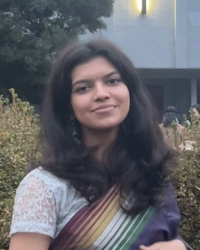
BALA SRI SKANTHINI J.M.
Lady Doak College, India
The JSL Programme in Japan was a unique and enriching learning experience that combined academic exposure with deep cultural immersion.
Designed to enhance global understanding, the programme provided an opportunity to engage with Japanese society, language, and traditions in a meaningful and hands-on way. One of the most valuable aspects of the programme was its emphasis on experiential learning. Instead of limiting learning to classrooms, the JSL programme encouraged participants to observe, interact, and reflect.
Everyday experiences, such as navigating public transport, interacting with locals, and participating in cultural activities became powerful learning moments. This helped develop adaptability, independence, and cross-cultural communication skills. The programme also offered insight into Japan's educational practices, work culture, and social values such as discipline, respect, and collective responsibility. Interactions with students, educators, and community members allowed for the exchange of perspectives and ideas, fostering mutual understanding and global awareness.
Beyond academics, the JSL Programme was personally transformative. Living in a new country challenged comfort zones and encouraged self-growth. It strengthened
problem-solving skills, confidence, and cultural sensitivity. Exposure to Japan's rich history alongside its modern innovations created a balanced understanding of the country's identity.
Overall, the JSL Programme in Japan was more than just an educational trip it was a holistic learning journey. It broadened horizons, built lifelong skills, and left a lasting impact by
promoting cultural appreciation and global citizenship.
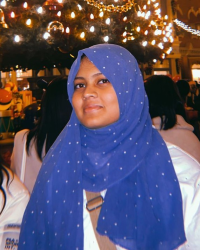
ZAFIRA M.
Lady Doak College, India
The Japan Service-Learning (JSL) programme has been a deeply enriching and transformative experience for me. It provided a unique opportunity to engage with Japanese communities while gaining valuable insights into culture, sustainability, and social responsibility. Through meaningful interactions and hands-on activities, I learned the true value of service and collective effort.
Participating in activities such as composting and emergency helped me understand the importance of environmental responsibility and community safety. These experiences showed how disciplined practices and cooperation contribute to a well-functioning society. Observing and participating in these initiatives encouraged me to reflect on how similar practices could be implemented in my own community.
One of the most memorable aspects of the programme was the warmth and hospitality of the people. Home visits and interactions with local residents made me feel welcomed and cared for, creating a strong sense of belonging despite cultural differences. These moments highlighted the importance of empathy, respect, and human connection.
The JSL programme also contributed significantly to my personal growth. Living independently in a new country improved my confidence, communication, and adaptability. Overall, this experience has broadened my perspective and inspired me to apply these learnings in my academic journey and future community engagement.
Voices of ICU Students joined as Volunteers
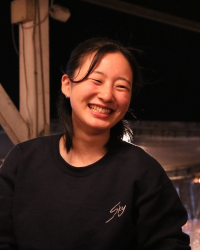
MICHIRU JITSUHARA
Joined service activity at Petra Christian University, Indonesia in AY2024
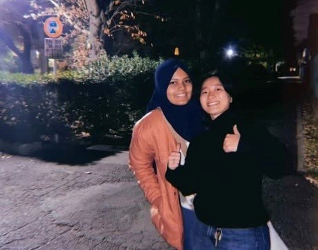
I volunteered for the JSL for about two weeks in December. In this reflection, I’d like to share memorable lessons I learned during that time.
The first thing I noticed through the activities was the presence of “culture” which I came to recognize through my interactions with international students specifically while in Japan. I’ve had many opportunities to encounter different cultures abroad, such as during the Service-Learning in Indonesia. However, the “easily described cultures” like trends or education systems that often come up in those settings were quite different from the deeply embedded, often unconscious cultural aspects. When I asked international students questions like “What surprised you when you came to Japan?”, I was repeatedly struck by how many of my everyday habits were not universal. It was also memorable to see how I could help reshape some made me realize the unique value of cultural exchange within Japan. Seeing myself through others’ perspectives gave me the chance to reexamine what I had always taken for granted.
Another important lesson was the danger of generalizing culture. Sometimes, when I shared what I thought about someone’s country, their reactions were completely different from what I expected. This made me realize that no single country can be defined by just one trait. Even people from the same country can have vastly different upbringings and values. I learned the importance of seeing others both as representatives of their country and as individuals. This applies to how I talk about Japan as well—there are very few things that can be said to represent all Japanese people. Our perspectives are diverse, and it’s important to acknowledge that.
I also learned a lot about the attitude we bring when exchanging cultures. Some of the questions from international students felt biased at first, but I realized that if I became defensive in those moments, I would miss out on valuable insights. Asking “Why do you think so?” or “Where did you hear that?” became the first step toward meaningful dialogue. Because JSL was a space built on mutual learning, we were able to talk openly about things that might be hard to discuss even among friends. And since we acknowledged our differences from the start, we felt comfortable asking each other questions. At the same time, I learned the importance of being honest and apologizing when I made mistakes.
Through these experiences, I came to deeply appreciate how international exchange in Japan can prompt reflection on my own values and upbringing. I used to associate international exchange mainly with going abroad, but I now realize how rich learning can be right here at home. Next, I hope to visit the countries of the friends I met through JSL and see their environments and values with my own eyes. It’s given me something new to look forward to.
I’m truly grateful to have participated in JSL—it gave me so many valuable insights.
|
OTOHA SUZUKI
Joined service activity at Silliman University, Philippines in AY2025
In the summer of the 2025 academic year, I visited the Philippines as part of the International Service-Learning Program. By immersing myself in the lives of people in a developing country, I was able to gain insights that cannot be fully understood through lectures or data alone.
What made this experience truly special was the interaction with fellow ICU students, students from Silliman University, and the people from the facilities and communities we visited, as well as the staff and faculty members. Through these connections, I was able to understand the local context, plan activities accordingly, and align them with my own interests and concerns. That’s why I believe that human connection is an essential part of service-learning.
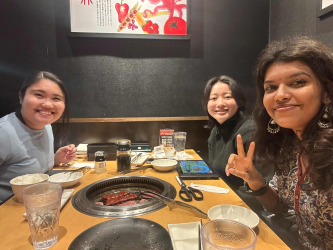
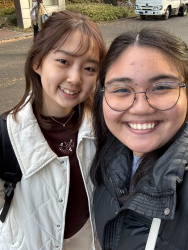
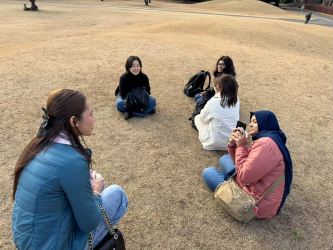
With this background, when I heard that four students from India and the Philippines would be coming to ICU for the Japan Service-Learning (JSL) program, I decided to volunteer, hoping to help make their experience in Japan as fulfilling as possible.
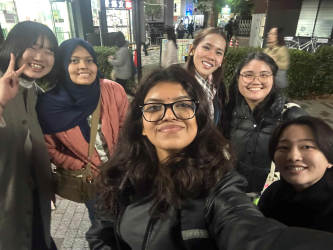
Together, we participated in activities like ICU Compost and campus tours, learning about Japan and ICU side by side. We also enjoyed casual conversations and shopping together. It was a joyful time that allowed me to relive the spirit of service-learning once again.
During their final presentations, the four students reflected on their learning, activities, and personal growth in Japan. I was deeply moved to see that their interactions with us volunteers, faculty, and others had become a meaningful part of their experience. In particular, their perspectives—such as examining Japanese social issues through the lens of their own cultures—were refreshing and offered me a valuable opportunity to rediscover Japan from a multinational point of view.
Including the new friendships I made, this was truly a memorable and enriching experience!
|
Voices of JSL Partner Organizations

Ms. YOSHIMI NISHIKAWA
Chi-Q-Jin
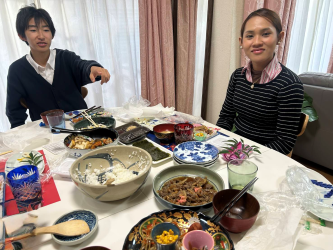
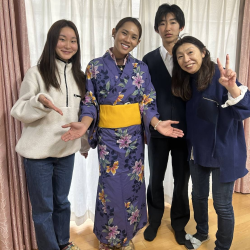
We welcomed an international student from the Philippines and a student from ICU into our home for a home visit. Through activities like an “onigiri party,” a “matcha experience,” and card games, we shared simple moments of everyday life in a Japanese household.
During the onigiri party, everyone enjoyed choosing their favorite fillings and making their own rice balls, trying a variety of flavors—from traditional Japanese ingredients to some unique twists. Our conversations flowed naturally, covering diverse topics such as Filipino food culture and how Japanese people spend their time.
Since the international student was interested in traditional clothing, we also had her try on a yukata. Although the time we spent together was short, it seemed they were able to truly experience Japanese culture through food, lifestyle, and hospitality, and their smiles throughout the visit left a lasting impression.
It was also a valuable opportunity for my junior high school son to interact in English. Through the interactions, a sense of closeness naturally grew between us, and it became a wonderful experience that broadened our worlds. I truly hope that this encounter will lead to many more opportunities for shared experiences and meaningful connections in the future.
 |
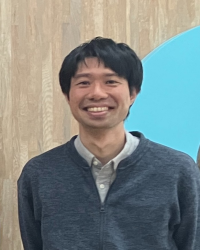
Mr. TAKAFUMI OHYAMA
Cosmo High School
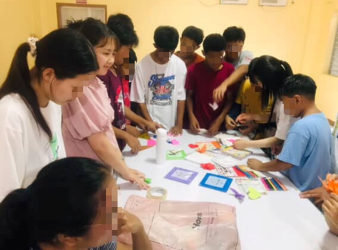
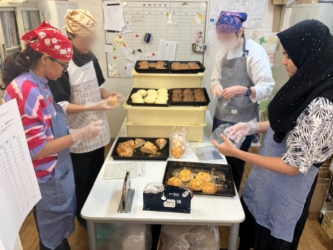
The Free School Cosmo High School is a learning space for high school-aged students located in Mitaka City. This year as well, we welcomed four students participating in the JSL, and together we engaged in cooking programs and work experience at our on-site community bakery, Kaze no Sumika. (Some activities also took place in the Junior High School)
At first, some of our Free School members expressed that “I still find it challenging to use English.” But after the activity, they reflected on the experience, saying things like, “There were many parts I couldn’t catch, but we managed to cook and bag the bread together, so I felt like maybe I could communicate somehow.” “I joined last year too, but I mostly stayed on the sidelines. This year, there were fewer members, so I had no choice but to step forward — I feel like I was able to interact this time.”
Hearing these reflections, I felt that even if students are hesitant and observe from the sidelines at first, with continued opportunities to engage with international students from ICU, they can gradually become more actively involved.
|

Ms. KEIKO SAHASHI
Koka Gakuen Elementary School
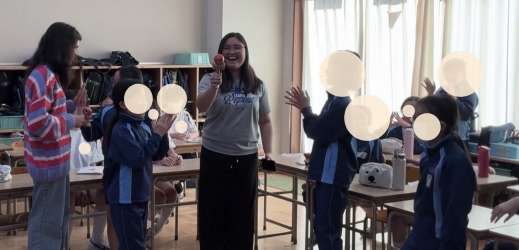
We at Koka Gakuen Elementary School are honored to welcome the international students from ICU and deeply appreciate the valuable time we have spent together learning from one another’s cultures. Through these exchanges, our students not only learn about cultures from other countries but also begin to reflect on the lives and values behind them, sparked by new discoveries. At the same time, these experiences give them an opportunity to reexamine and appreciate their own culture.
Even in today’s world, where ICT is deeply integrated into education, we are continually reminded of the profound impact of face-to-face human connection. We’ve seen quiet students, who usually say little, approach international students with unspoken curiosity and try to teach them how to play Kendama using gestures alone. Watching their hearts gradually connect through these interactions is a powerful form of learning born from real experience—an approach to education we believe is more important than ever. We are truly grateful for the opportunity to engage in such meaningful exchanges again this year.
 |
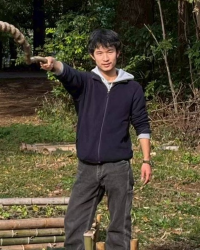
Mr. MATO KIZU
ICU Compost
Just like last year, we were delighted to welcome two students each from the Philippines and India to join our composting activities again this year! "Our activities began with a simple question: could we do something about the large amount of food waste being thrown away in the dormitory? We deepened our connections over two relaxed sessions, walking around as we introduced the dormitory and breaking down discarded vegetables into small pieces with shovels. Their humorous perspective as they tried composting for the first time was memorable. They likened the process of mixing food scraps and fallen leaves into shape to cooking, and with a playful sparkle, sprinkled the final layer of leaves while declaring, “We’re ready to serve!” I’ll never forget how they jokingly called the cloudy rinse water from washing the buckets “milk tea.”
Composting can be tough to do alone, and the smell or appearance might be off-putting at first—but thanks to everyone, it became an unforgettable and meaningful experience.
 |
Coordinators of JSL Program
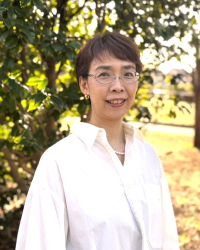
YOKO YAMADA
Coordinator of Community Service-Learning
From December 8 to 22, we carried out the Japan Service-Learning Program (JSL), welcoming four students from Lady Doak College in India and Silliman University in the Philippines. During their stay, they took part in a wide range of activities, including supporting English classes at Higashi Elementary School (Koganei City) and Koka Gakuen Elementary School (Chofu City), engaging in international exchange at Free School Cosmo (Mitaka City), participating in events organized by the local group Chi-Q-jin (Koganei City), and joining home visits. On campus, they also learned about environmental initiatives through the student group ICU Compost and the conservation efforts for “Mitaka Osawa Wasabi.” In addition, they visited the Kobokan Community Center (Sumida Ward) and went on an excursion to Tokyo Skytree.
The four students quickly bonded from their first day in Japan and consistently worked together extremely well. Despite the short two-week period, they reflected deeply on their experiences, considering the differences and similarities between Japan and their home countries, as well as the cultural and social contexts behind them. Their interactions with local children highlighted many moments when hearts connected beyond language barriers, allowing us to feel once again the warmth that arises from genuine exchange.
We would like to express our heartfelt gratitude to all the host organizations and everyone who supported this program and warmly welcomed the students.
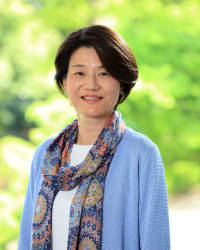
ATSUKO KURONUMA
Assistant Professor by Special Appointment
Education, Assistant Director of Service-Learning Center
This year's JSL program focused on Japanese school culture, educational challenges, and sustainability. During reflection sessions, participating students compared their own societies and cultures, identifying shared concerns and discussing differences rooted in their social and cultural backgrounds. It was impressive to see students from India and the Philippines thoughtfully considering how they could use their knowledge and experiences to contribute to and serve their communities, even while living in competitive social environments. Furthermore, students who initially had idealized views of Japan came to recognize the diverse challenges present in this society. Through this process, they reflected on the importance of engaging with social issues as global citizens. We hope this program provided everyone involved with new insights and meaningful learning opportunities.
Reflecting ICU by the Graduating Students
Many ICU students will leave campus for graduation in March 2026. Here are some students who served as Service-Learning (SL) Ambassadors. They participated in activities to promote Service-Learning to many high school students and current students.
SL Ambassadors: Students who have experienced 30-day service activities at domestic or overseas, and participated in activities to promote service-learning inside and outside the university.
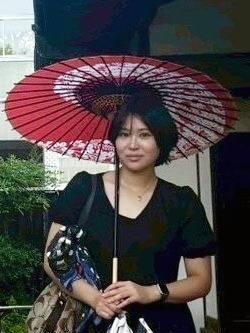
MIKO KUZE
Joined service activity at The Nagasaki Foundation for the Promotion of Peace, Nagasaki Prefecture in AY2023
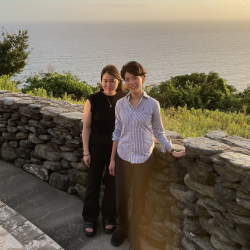
It’s already been two years since I participated in the Service-Learning Program in Nagasaki
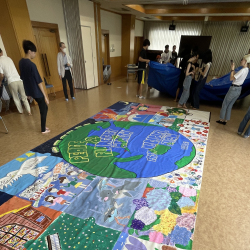
in 2023. I have many memories from that one-month stay, which I shared with a friend majoring in education. As a student pursuing a museum studies course, I joined the program with a question in mind: what improvements could be made to the exhibits at the Nagasaki Atomic Bomb Museum? We visited various disaster heritage sites, museums, and churches, learning deeply about Nagasaki’s history. But it wasn’t just about learning—we also worked with local students to enliven the summer in Nagasaki, volunteered for peace-related activities, and facilitated programs that encouraged children to think about peace.
Starting this spring, I will begin working as a news reporter, responsible for gathering information and conveying it clearly, accurately, and swiftly. One of the key experiences that inspired me to pursue journalism was my time in Nagasaki during the Service-Learning Program. From the time I entered university, I had already decided to major in international relations, drawn to the roles of leaders working within international frameworks like the United Nations and the Ministry of Foreign Affairs. However, during my second year, I felt a strong desire to turn my attention to Japan’s own history, which led me to participate in the program. There, I encountered Nagasaki’s unique approach to peace education and learned that the city’s wartime experiences extended beyond the atomic bombing. I was struck by the complex history Nagasaki has endured to this day. Throughout the program, I became acutely aware of how little I had known before.
I also had the opportunity to meet Professor Yoshida, the director of the Research Center for Nuclear Weapons Abolition at Nagasaki University, who once taught public policy at ICU. He shared his experiences as a long-time journalist for the Asahi Shimbun and offered profound insights into nuclear deterrence. Having reported both domestically and internationally, Professor Yoshida has seen Japanese and global society with his own eyes. His efforts in nuclear disarmament, grounded in firsthand experience, conveyed a sense of purpose that only someone with direct exposure to the field could possess. I was deeply moved.
Through these experiences, my perspective shifted—from a broad view of the world and nations to a more localized focus on communities and the people who live in them. Rather than becoming a leader at the center of policymaking, I realized I wanted to be a journalist working on the ground, running around to gather stories for the sake of others. I hope to become someone who contributes to society with a firm conviction built through lived experience.
The Service-Learning gave me the chance to reexamine my academic path and discover a guiding light for my future. It wasn’t all joyful—there were moments of shock, and I grappled with the discomfort of being an outsider in the communities we visited. But I’ve come to believe that those very moments of discomfort and emotional upheaval are what make an experience meaningful. It’s important not to look away from them. Many people choose to immerse themselves in unfamiliar environments when they participate in Service-Learning. My tip is this: first, fully embrace the place you’re in, and then pay attention to the changes you feel as you engage in your activities!
|
SATSUKI OYABU
Joined service activity at the Toho Elementary, Tokyo in AY2022
The Service-Learning Program was undoubtedly one of the highlights of my university life.
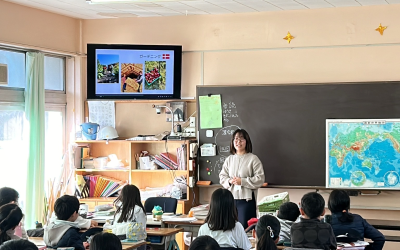
My experience at Toho Elementary School was incredibly valuable, especially for someone like me who had a vague dream of becoming an elementary school teacher. Immersing myself in the school environment and meeting many inspiring role models helped me solidify that dream and strengthened my desire to pursue it more seriously.
What first drew me to Toho Elementary was learning about the work of Mr. Toshiki Hoshino, introduced in the book To the Boys of the Future: Lessons for Breaking Free from 'Manliness'. Discovering his approach to comprehensive sex education made me realize, “This is the kind of education I want to pursue!” When I read in his profile that he worked at Toho Elementary and saw on the map that the elementary school was very close to ICU, I felt it must be fate.
I was also deeply drawn to Toho Elementary’s educational mission: ‘For a Happy Childhood.’ In many educational settings in Japan, children are constantly pressured to strive for their future, often at the expense of simply being children. I found it wonderful that this school places importance on allowing children to grow in a childlike way during their childhood. Every time I participated in activities at Toho, I could truly feel this mission being put into practice.
During my time there, I was mainly involved with the 5th grade West Class. In their class, they had a rule to call each other by the names they preferred, so I was affectionately called “Yabu-Yabu,” a nickname derived from my surname.
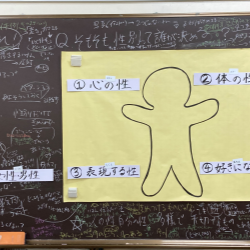
Their homeroom teacher, Mr. Igaki, gave me many opportunities to take on new challenges, such as leading a five-minute morning activity called “Yabu-Yabu Time” to share messages with the students, and even teaching a class on gender diversity. The class on gender diversity was titled “A Lesson on the Heart and Body of Gender.” I prepared the lesson with guidance from Mr. Hoshino, who kindly offered advice multiple times. Using a comment made during a PE class— “You’re a boy, so you should run faster”—as a starting point, we explored ideas like femininity and masculinity, how many genders there are, and who decides them. The students shared their honest thoughts during the lesson, and some even wrote in their feedback that their understanding of gender had changed.
I spent up to four days a week with the 5th grade West Class, sometimes for the entire day. They showed me sides of themselves that they didn’t show their regular teachers. I wasn’t quite a teacher, but more like an older friend, and they often helped me out when I was in a pinch.
At first, I only knew how to build relationships by giving praise and using positive words. But one day, a few students told me, “You don’t have to flatter us,” and “You don’t have to force compliments.” I realized then that they saw right through me, and I was humbled.
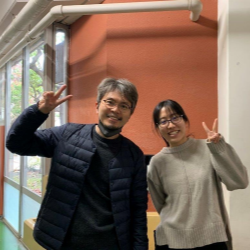
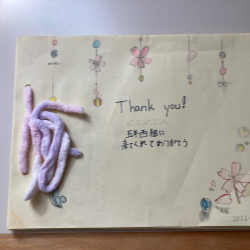
On my last day with the 5th grade West Class, they gave me a booklet filled with handwritten letters from each student. We sat in a circle, and one by one, they read aloud their comments, advice, and words of encouragement. One student wrote, “I think it’s great that you’re always smiling. Just be careful not to overdo the compliments. But I believe you’ll become a great teacher, Yabu-Yabu. I’m cheering for you.” I couldn’t hold back my tears.
Even after the Service-Learning Program ended, I’ve continued volunteering at Toho Elementary. I’ve been invited to various school events, where I’ve learned more about their unique educational approach. Comparing it to my own experience in public elementary school has been both inspiring and enlightening.
After graduating from ICU, I plan to travel around Japan to visit alumni of my alma mater whom I featured in my senior thesis. Through these visits, I aim to document their life stories and explore how the education they once received has shaped their paths. These insights will serve as valuable references when I become involved in education.
Starting this fall, I will begin studying at a distance-learning university in Tokyo to obtain my elementary school teaching license. While gaining diverse life experiences, I intend to continue pursuing my dream of becoming an elementary school teacher. I also hope to draw on the many experiences I gained at Toho Elementary School to help create an environment where children can fully live their childhood in their own ways, including in relation to their gender and sexuality. In addition, I want to keep learning alongside the children and take on the challenge of building a "better society" together.
|
Message from the Director of SLC
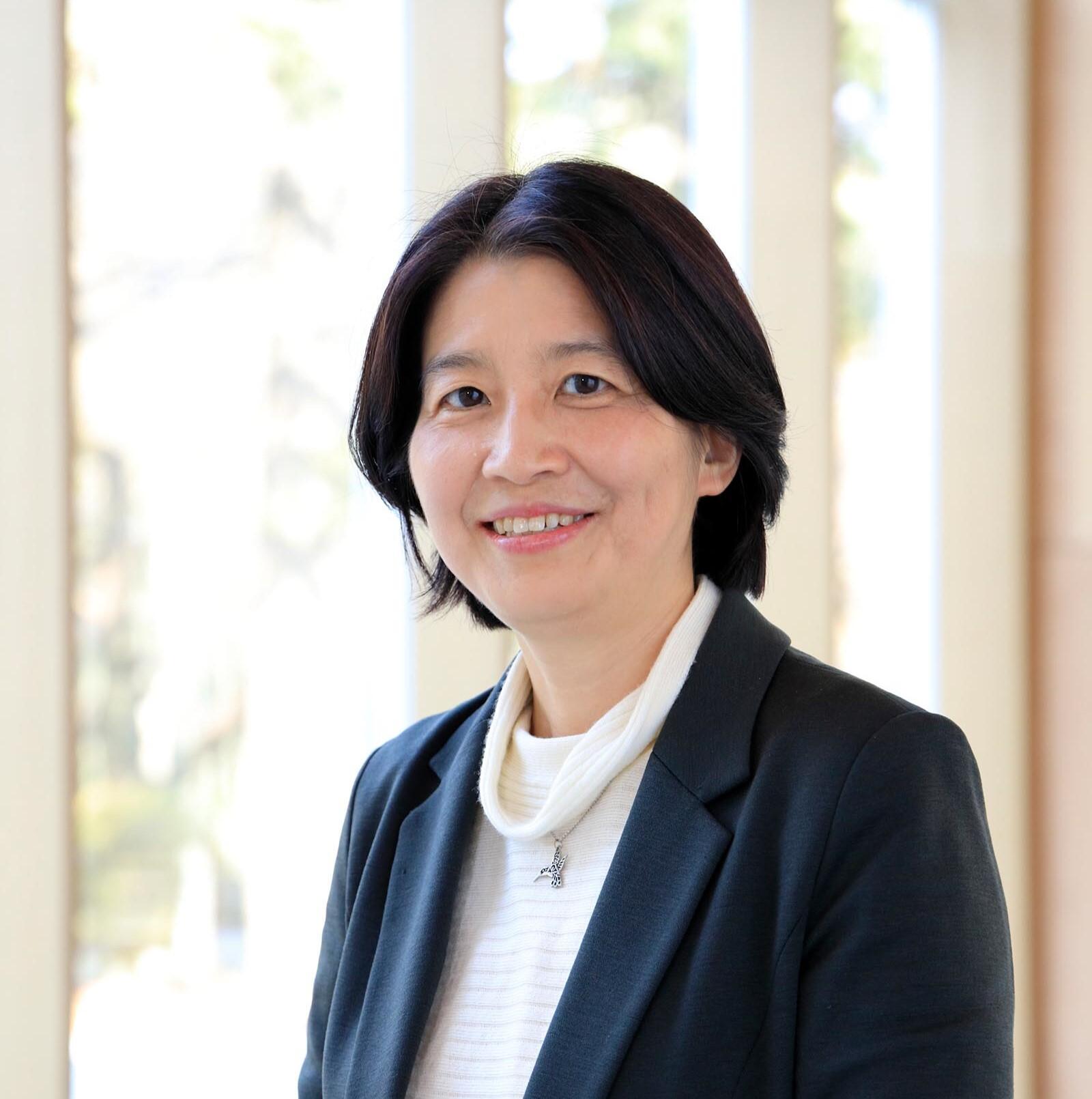
ETSUKO KATO
Professor, Cultural Anthropology
Director, Service-Learning Center
What kind of season is “autumn and winter” for the field of Service-Learning (SL) programs?
In truth, it’s a bustling time—harvesting the crops grown in the “summer” and preparing to sow seeds for the coming “spring.” As soon as reflection classes and grade evaluations wrap up, revisions for next year’s programs and the screening of new applicants begin. At the same time, we welcome SL exchange students from our overseas partner universities (JSL program), and offer “multiple harvests” through 300-level courses and more. This field never lies fallow. But make no mistake—this SL field is no paradise. Students, often with limited life experience and knowledge, venture out to meet people facing real challenges, and in doing so, they are tested both mentally and physically. Yet those who absorb rich nutrients from this field grow into vegetables of all colors and shapes, each adding a unique “flavor” to the global salad bowl—flavors that can’t be cultivated in the classroom alone. To all of this year’s SL participants: as you pass the baton to the next generation, may your major studies and future careers bring out your own distinct and wonderful taste.
Editor's note

Growing up, I moved from school to school, always anticipating farewells. That’s why I like how ICU calls its graduation ceremony “Commencement.” It’s not an ending, but a beginning. May the bonds formed here lead to new encounters.
 In the spring, when I graduated from high school and left my parents’ home, I experienced living alone for the first time. While it offered freedom, I also learned the difficulty of taking responsibility for every aspect of my life. Realizing how much I had been supported by those around me, I developed a renewed sense of gratitude.
 The day I moved to Tokyo for university. I was excited about the bright, new life ahead, yet trembling during the earthquake on my very first night, I truly realized what it meant to have no family nearby to rely on—the loneliness and the small resolve it stirred within me. Those mixed emotions return vividly to me in this season.
 As spring approaches, I find myself entering a familiar season of departure once again. Leaving winter behind, I am inevitably sent off into a new battle with hay fever—an unseen adversary carried through the air by pollen. It is a journey I undertake unwillingly each year, yet I try to accept it as a quiet seasonal rite and prepare myself with as much dignity as the circumstances allow.
 As graduation approached, I had chosen my path, though it meant moving even farther away. I hesitated, worried about leaving my still recovering mother. In this season of farewells, I recall the gentle words of my mentor that encouraged me to take the next step.