

Spring Term AY2026
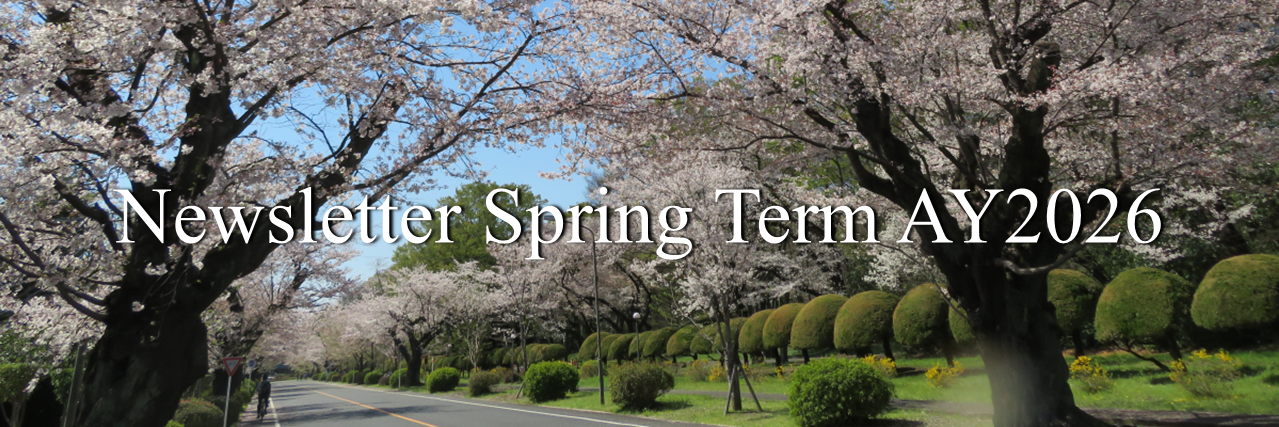 photo: MacLean Avenue, ICU
Fresh greenery brightens the season, and a refreshing atmosphere fills the campus as the spring term unfolds. This year, many students enrolled in the “Introduction to Service-Learning” course, engaging not only in classroom study but also in service activities in local communities and social settings, where they reflected on their own interests and questions. Moving between the classroom and the field, these experiences have brought new insights and depth to their everyday learning.
This summer, 50 students will participate in International Service-Learning, 14 in Community Service-Learning, and, as part of faculty-led programs, 4 students will travel to Kenya and 4 to Thailand. Each group will engage in activities in different regions, gaining a wide range of experiences.
In this issue, we focus on the theme “Service-Learning Experiences and University Learning,” taking a fresh look at how service-learning connects with academic learning at the university. We hope this issue will offer a glimpse into how the insights gained through field experiences can develop into and enrich further learning.
Topic
Contents
- Service-Learning (SL) Experiences and Learning at the University: When Experience Becomes Academic Inquiry
- Community Service-Learning, Nagasaki
- International Service-Learning, India
- Service-Learning in Liberal Arts Education
- Message from the Director of SLC
- Editor's note
Service-Learning (SL) Experiences and Learning at the University: When Experience Becomes Academic Inquiry
In this special feature, we explore how SL experiences connect to learning at the university from the respective perspectives of student and faculty (SL Advisors). At ICU, the Service-Learning program incorporates an SL Advisor system, in which students proactively select a faculty member and receive guidance and academic supervision before and after their field activities.
In this issue, we present contributions from two student-advisor pairs who engaged in Community Service-Learning in Nagasaki and International Service-Learning in India. Drawing on their disciplinary expertise and advising experience, the faculty members examine how SL relates to the development of academic thinking and the formation of research questions, while the students reflect on how their experiences and processes of exploration connect with their academic interests.
Community Service-Learning, Nagasaki

HANNA YOSHIDA
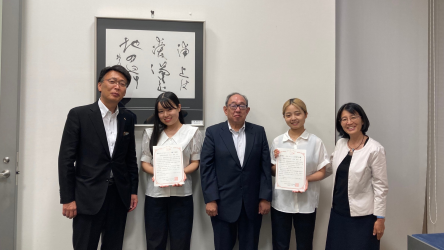
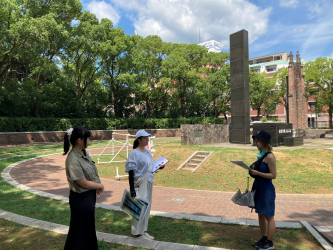
Joined Community Service-Learning at Nagasaki, 2025
My academic majors are Cultural Anthropology and Gender and Sexuality Studies (GSS). Cultural anthropology is a discipline that seeks to understand and analyze specific societies and cultural groups from an insider’s perspective, while GSS examines structural and cultural forms of discrimination in society, with a particular focus on gender. I am especially interested in how oppressive power relations within communities are shaped by gender and race.
During SL program in Nagasaki, I focused on the perspectives of groups who are often marginalized—particularly women and Korean hibakusha (atomic-bomb survivors of Korean origin )—and wrote my final report specifically on Korean atomic bomb survivors on the latter. I chose this theme because, through the academic literature I read beforehand, I learned that while public narratives of Nagasaki’s hibakusha tend to center on “victimhood,” the experiences of women, persons with disabilities, Zainichi Koreans, and children are often pushed to the margins. This led me to seek guidance from Professor Takamatsu, hoping to explore how structures of perpetration and exclusion are embedded within Nagasaki’s atomic bombing narratives from a gendered perspective.
The academic learning I gained through SL closely resembled fieldwork and participant observation in cultural anthropology. In fact, participating in SL clarified my desire to study anthropology more deeply. As an outsider entering the local community, I joined various events through the Nagasaki Foundation for the Promotion of Peace and the Research Center for Nuclear Weapons Abolition of Nagasaki University. Through these experiences, I realized that, in the narratives of atomic-bomb experiences, "social attributes" play a significant role and that gender imbalance exists in certain contexts. When I struggled with how to theorize these observations, Professor Takamatsu advised me to consider the historical and social backgrounds that have reinforced particular narrative positions. This helped me understand that atomic bombing narratives are not merely historical records but are complex and deeply intertwined with Nagasaki’s local history and social structures. It also encouraged me to explore the city further to better understand its layers of meaning.
My SL experience, grounded in academic inquiry, was incredibly rich—I even filled four field notebooks with new discoveries and reflections. This process of deepening my thinking continues to support my current senior thesis research, and it is a learning attitude I hope to carry forward.
|
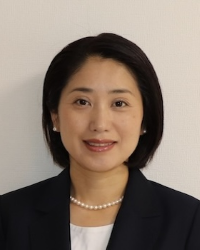
KANA TAKAMATSU
Senior Associate Professor, Department of Arts and Sciences (Major: Development Studies, Gender and Sexuality Studies, Peace Studies)
Through my role as an SL advisor, I have the opportunity each year to support several students engaged in service activities at different sites. Drawing on these experiences, I would like to reflect on how students’ service experiences connect with the development of academic thinking.
In post-service advising sessions, many students describe how their on-site experiences have deepened their understanding. At the same time, it is not uncommon to hear about moments of conflict, confusion, or wavering confidence. Yet I often feel that these very experiences become valuable catalysts for learning—crucial starting points from which new academic inquiries emerge. In my advising with Ms. Hanna Yoshida, who has contributed to this newsletter, I believe I witnessed precisely such a process of learning unfold.
Two years before serving as Ms. Yoshida’s SL advisor, I visited Nagasaki with a group of graduate students. The insights I gained during that visit left a strong impression on me, and perhaps because of that background, I found myself resonating deeply with many aspects of Ms. Yoshida’s reflections on her SL experience in Nagasaki. From the outset, she approached her service with a clearly articulated intersectional perspective and a strong academic sense of inquiry. As she engaged in various activities on site, this perspective further developed, leading her to recognize how “social attributes” shape the narratives of atomic bomb experiences—and to critically question whether certain experiences may remain insufficiently visible depending on those attributes. Her inquiry thus expanded beyond individual experiences toward broader historical and socio-structural analysis. I felt that this progression exemplified how insights gained through service can evolve into well formed academic inquiry.
In this way, Service-Learning offers a meaningful process: one in which students revisit the empathy, tensions, and discoveries arising from their on-site experiences through an academic lens, reexamine their own assumptions, and cultivate new scholarly inquiry. I am truly grateful for the opportunity to be involved—even in a small way—in such learning processes as an advisor, and I look forward to it every year.
International Service-Learning, India
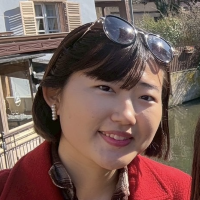
MIKU NAKAMURA
Joined International Service-Learning at Lady Doak College (India), 2022
A Journey Begins: To Tamil Nadu, South India
— Discovering the “Excitement” of Education through Service-Learning —
My Service-Learning experience at Lady Doak College was stimulating every single day and offered continuous opportunities for learning.
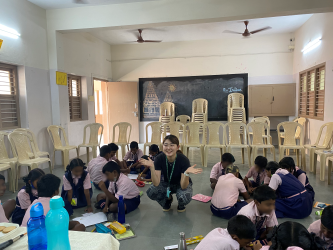
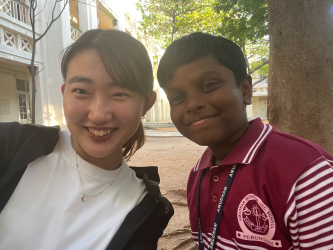
What left the deepest impression on me was the importance of dialogue. One of the key concepts in SL is needs analysis. We began by visiting the primary schools where we would teach, engaging in conversations with teachers and students to understand their interests and needs. As we designed our lessons, we grappled with questions such as: “What themes would encourage students’ active participation?” and “What kinds of critical awareness do we hope students will take away?”
A major source of support in deepening these questions was my SL advisor, Professor Masanori Kondo. From pre-departure preparations to on-site activities and even the post-activity report writing, he guided me at every stage. In particular, the conversations I had with him in India significantly enriched my learning. Through our discussions, I came to realize that lesson design is not something educators determine unilaterally; rather, it is shaped through dialogue with local stakeholders—teachers and children in the community.
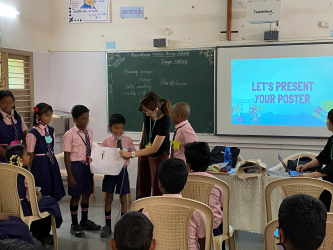
Through these ongoing conversations, we eventually decided to focus our lesson on Gender Equality. In India, gender-related issues—including discrimination against women and domestic violence—remain pressing concerns. Local teachers also expressed a desire for lessons on gender, and the students themselves showed strong interest. With this in mind, we aimed to create lessons that would present gender equality in a clear and relatable way, grounded in India’s social context.
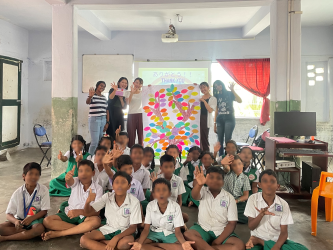
After much trial and error, we implemented a lesson that incorporated participatory activities such as poster-making on gender equality. At the end, we posed questions such as:
“How can we build a society where people are free to express themselves without being constrained by fixed ideas of ‘femininity’ or ‘masculinity’?”
“What is necessary to create a society in which people of diverse genders respect and support one another?”
These questions provided students with opportunities to think independently and share their ideas.
|
Connecting to My Academic Field
I am currently pursuing a master’s degree in education, with a particular interest in history education. My research examines how the history of the Atlantic slave trade is taught in Ghana’s secondary education—specifically, how it is positioned within curricula and how teachers understand and convey it.
At first glance, my SL experience in India may seem unrelated to my current research. Yet, they share a fundamental question:
“Who constructs educational content, and within what social and cultural contexts?”
Through lesson design in India, I learned that education is not merely the transmission of knowledge. It is shaped by the culture and values of the local community, as well as by the perspectives of those involved in teaching. Even when addressing the same topic, the intentions and critical awareness of the instructor can significantly influence how the content is conveyed and how learners receive it.
This insight directly informs my current research in history education. My interest in how the slave trade is narrated in schools—how teachers interpret this history and communicate it to students—stems from the learning I gained through SL.
|
Beginning next April, I will be working at JICA. I expect to engage with people in many different countries and regions, and I believe that the learning and encounters from SL will serve as an invaluable guide as I work with individuals who hold diverse cultural backgrounds and values. My experience in India will continue to sustain me—not only as a researcher but also as a practitioner in international cooperation.
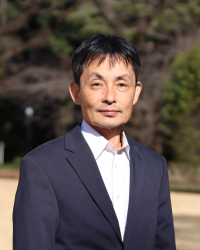
MASANORI KONDO
Senior Associate Professor, Department of Arts and Sciences (Major: Economics, Development Studies)
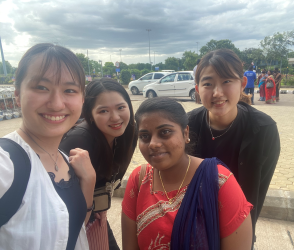
From July 11 to 22, 2022, I visited Lady Doak College in Madurai, located in southern India, accompanying Ms. Miku Nakamura and two students for their Service-Learning program. As a scholar of development economics and the Indian economy, I believed I had a solid understanding of the region; however, the experience on the ground significantly reshaped my perspectives.
Through conversations with local students and faculty, I was struck by how profoundly cultural and institutional contexts shape the way social issues are understood. Topics such as educational inequality or disparities between urban and rural development, for example, are approached with priorities that differ markedly from those typically held by students in Japan.
In engaging with these differences, the participating students—including Ms. Nakamura—reexamined their own assumptions and values, gradually cultivating a broader and more nuanced worldview. Having grown up in the United States and being a native speaker of English, Ms. Nakamura delivered an impressive presentation to local students and faculty, demonstrating exceptional clarity and sophistication in both content and expression. She has since drawn on the insights gained through this program in her current graduate studies. To be candid, I had not anticipated such remarkable outcomes at the outset, but I came to realize how deeply meaningful this program was for her.
The essence of Service-Learning lies not in one-directional support but in the deepening of learning through reciprocal engagement. Through fieldwork and collaborative projects, students expand their focus from what they learn to how they come to know. Although such transformations are difficult to quantify, they are profoundly important for long-term intellectual and personal growth.
For the host institution in India as well, this program is far from one-sided. When students from different educational backgrounds work together, the exchange extends beyond sharing knowledge—it becomes a valuable opportunity to reflect on the very processes of learning itself.
This experience reaffirmed for me that Service-Learning should be understood not merely as practical field experience, but as a process of “reconstructing the self through relationships with others.” I sincerely hope that opportunities for this kind of international, collaborative learning will continue to grow in the years ahead.
Service-Learning in Liberal Arts Education
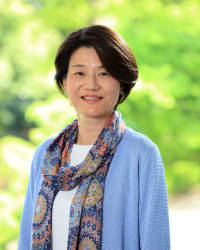
ATSUKO KURONUMA
Assistant Professor by Special Appointment
Education, Assistant Director of Service-Learning Center
I believe that one aspect of the academic significance of Service-Learning is that it encourages students to reconsider their views of society, their positionality, and how knowledge itself is created through service experiences and reflection. The two cases in this special feature illustrate this well. In Nagasaki, the student began to ask about experiences and voices that had been made invisible in narratives of the atomic bombing. In India, the student’s learning evolved into an inquiry about whose perspectives shape educational content and in what contexts it is created. These insights emerged as the students reexamined their own knowledge and assumptions through sincere engagement with local communities. Service-Learning Advisors, who are faculty members with expertise in various academic fields, support this process of forming and deepening inquiries through dialogue and reflection. The cases in this feature reveal Service-Learning in liberal arts education as a collaborative learning environment in which students’ experiences serve as the starting point for students and faculty to engage with both academic inquiry and society as they move between theory and practice through dialogue.
Message from the Director of SLC
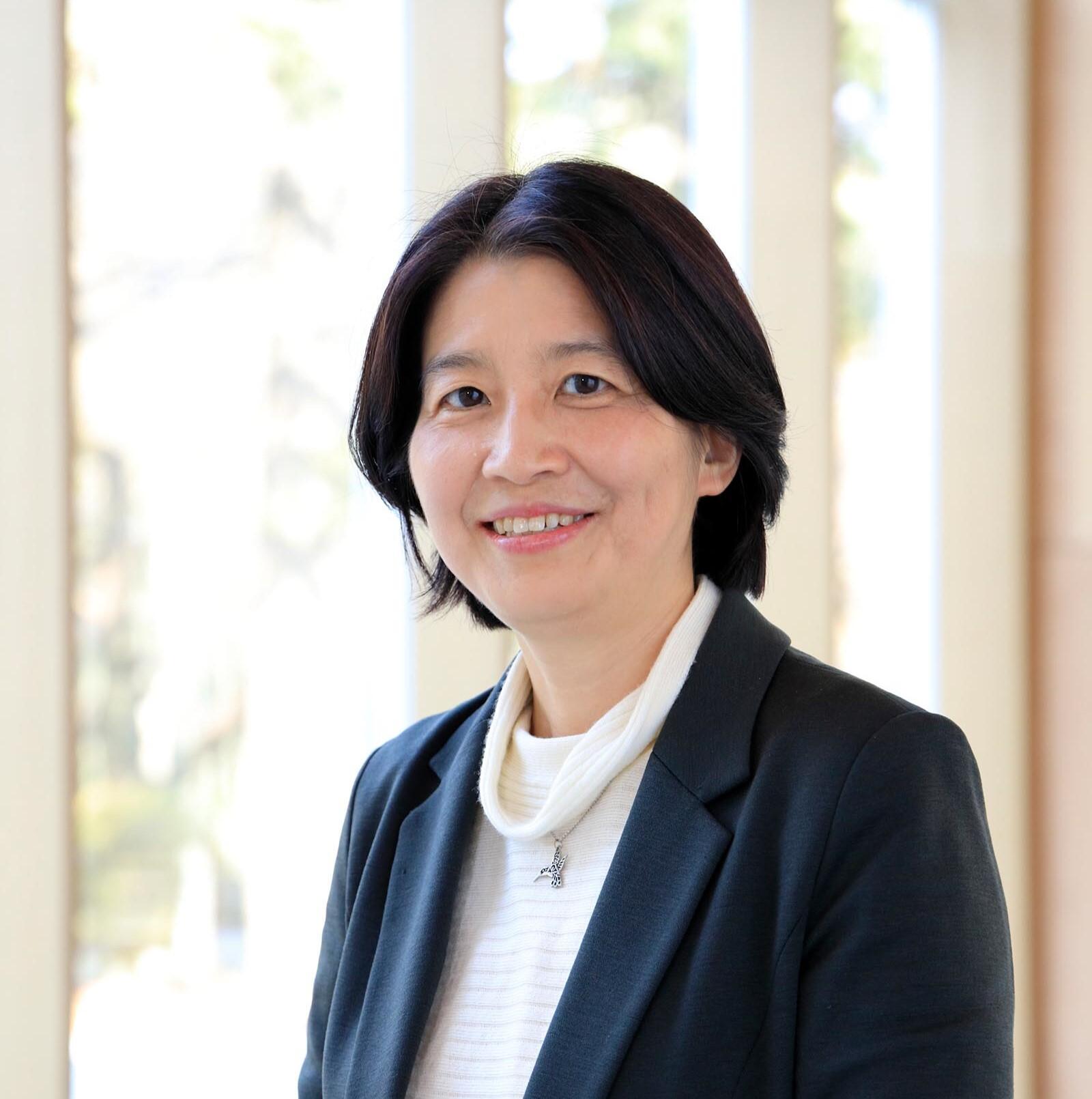
ETSUKO KATO
Professor, Cultural Anthropology
Director, Service-Learning Center
The most significant change this spring is that the GE course “Service-Learning” has become SLR101 “Introduction to Service-Learning”, now offered in English (with a Japanese section planned for the autumn). It may sound a little unusual, but until now, Service-Learning had no 100-level foundational course. Students would take the GE course and then suddenly leap to the 200-level—thirty days of domestic or international service—creating what looked like a rather steep jump. Now that the curriculum spans from the 100 level to the 300 level, it conveys a message similar to that of a major: “Let’s study this field in a structured, academic progression.” There is also great significance in the fact that nearly 70 students—most of whom are Japanese speakers—are now learning Service-Learning in English. More than half of them will be working abroad in English this summer, and even those serving within Japan will find that being able to use English broadens the scope of their activities. Not by trying to sound like native English speakers, but by conveying meaningful thoughts and emotions — and listening — in English shaped by one’s own linguistic background, global citizens communicate and keep our world moving forward, I believe.
Editor's note
“My Small Changes This Spring”

This spring, I hardly had a chance to wear long-sleeved shirts, spring knits, or my spring coat. It seems that both the Earth and I have become more sensitive to heat. In this small way, I felt changes in myself as well as in the climate.
 I have been studying Spanish with a mobile app for two years. Although I had not felt much progress, I was pleasantly surprised to realize that I could understand a Spanish website I happened to come across. This experience reminded me that small, steady efforts truly lead to meaningful change.
 I’m usually the type to give up quickly, but this spring I decided to turn things around and started working on my fitness. I haven’t seen much change yet, but I’m believing in small, steady efforts and hope to get through the summer without feeling run down.
 This spring, I started practicing touch typing. I am relearning proper key placement, especially for my smaller fingers. It still feels awkward at times, but I can sense gradual improvement, and I appreciate this small but meaningful change.
 A year of mindful walking has eased my foot pain and lightened my spirits, and as spring gently turns to summer, I find myself wishing to return to the mountain trails I love.